Why Crystals Prefer Symmetry
What the faces of a crystal can tell us about an arrangement too small to see.
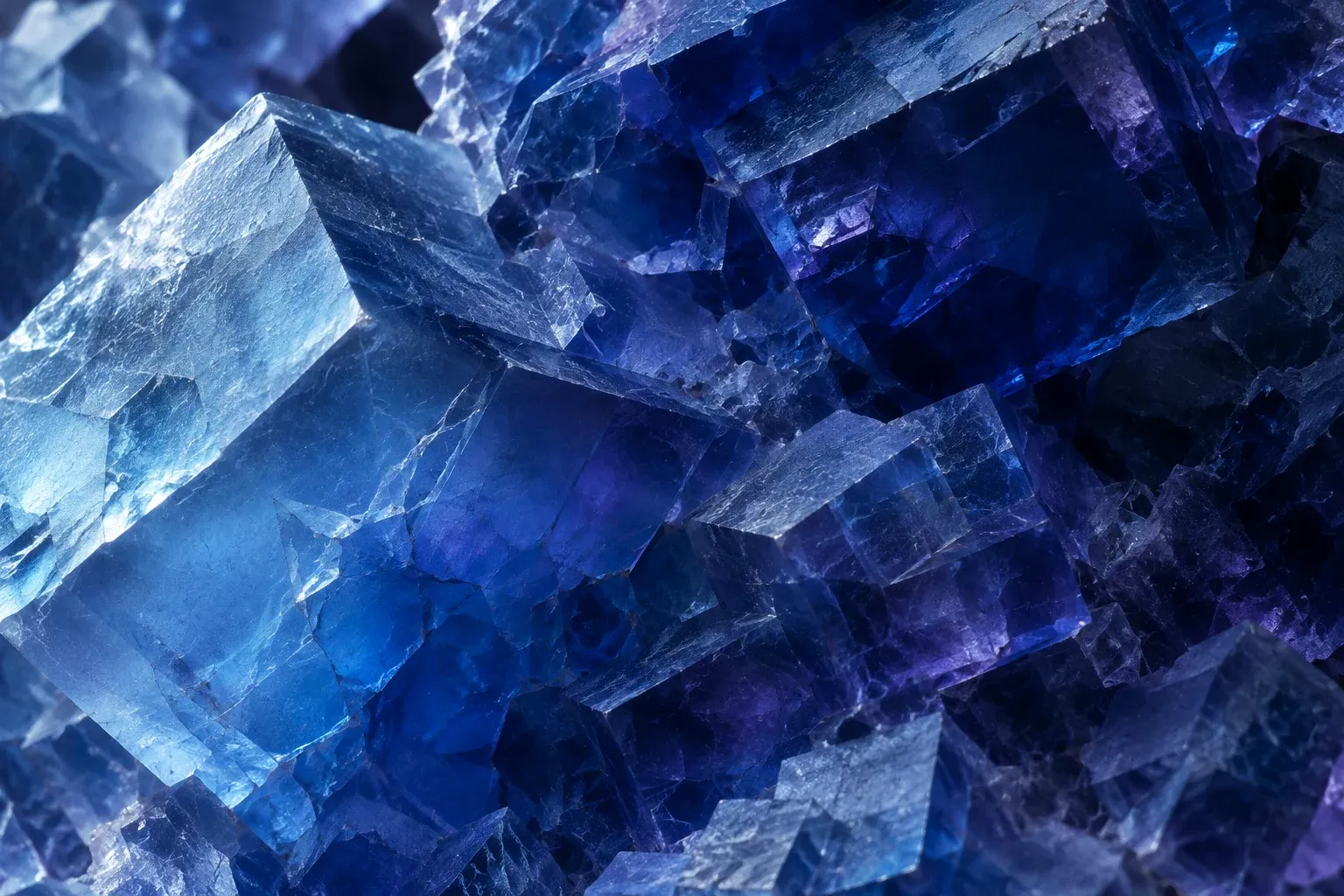
Turn a sharply faceted crystal in the light and one face goes dark while another flashes. On some specimens, edges meet at conspicuously regular angles. The hand can rotate the whole object. The imagination has to do something harder, following the order inward, past the visible steps and fractures, to a structure far smaller than the object on the table.
A rule for repeating space
A simple way to describe a periodic crystal is to separate two ideas. A lattice is an ideal array of points with equivalent surroundings. A motif is the atom or group of atoms associated with each point. Repeat the motif over the lattice and you have a model of an extended structure. The lattice itself carries no information about which atoms are present.
A unit cell is a region that tiles space when shifted by the right amounts in the right directions. Draw a floor in your mind and outline just enough of it to reproduce the pattern by sliding copies into place. There can be several choices of outline for the same pattern. Crystallographers use conventions to select a cell that helps communicate the structure.
Turn it, then look again
Symmetry describes which changes leave an arrangement looking the same. A shift by one repeat distance is a translation symmetry of an ideal periodic array. A square also has a different kind of symmetry. Turn it through ninety degrees about its center and its outline returns to the same place. Mark one corner and you can still tell where that corner moved.
In the geometry explorer, four curved blades behave similarly under rotation. Their outline survives a quarter turn. Hold up a mirror and the direction of the curve reverses. An arrangement can have one kind of symmetry and lack another. That is why the word symmetric gives too little information on its own.
Why faces offer a clue
Interactions between the constituents make some arrangements more favorable than others under particular conditions. Temperature, pressure and composition matter. The title’s word prefer is shorthand for these physical constraints. A highly symmetric outcome is one possibility. There are also crystals with much less symmetry, and some ordered crystals lack ordinary periodic repetition.
External faces can reflect the internal structure, but their relative sizes depend on how the specimen grew. A face may be small or missing because growth had less room in that direction. A break can expose a surface that tells a different part of the story. Identifying an internal arrangement therefore takes more than matching a silhouette. Diffraction is one way to test structural models using the pattern produced when radiation scatters from the material.
Next time you see a faceted mineral, start with what the shape lets you observe directly. Which faces recur? Which corners differ? Then consider what each observation can tell you about the structure, and what would require a measurement.
Figure 02 · Geometry explorer
Test the symmetry
Try a quarter turn and a mirror reflection on the same motif.
Four curved blades spiral around the center.
A quarter turn maps each blade onto the next. The shape occupies the same outline, while the marked point moves right.
A vertical mirror reverses the curve of each blade. The reflected blades differ from the pale original outline.