Geometry Across Civilizations
Repeating ornament takes on different meanings when it is cut into a wall or laid underfoot.
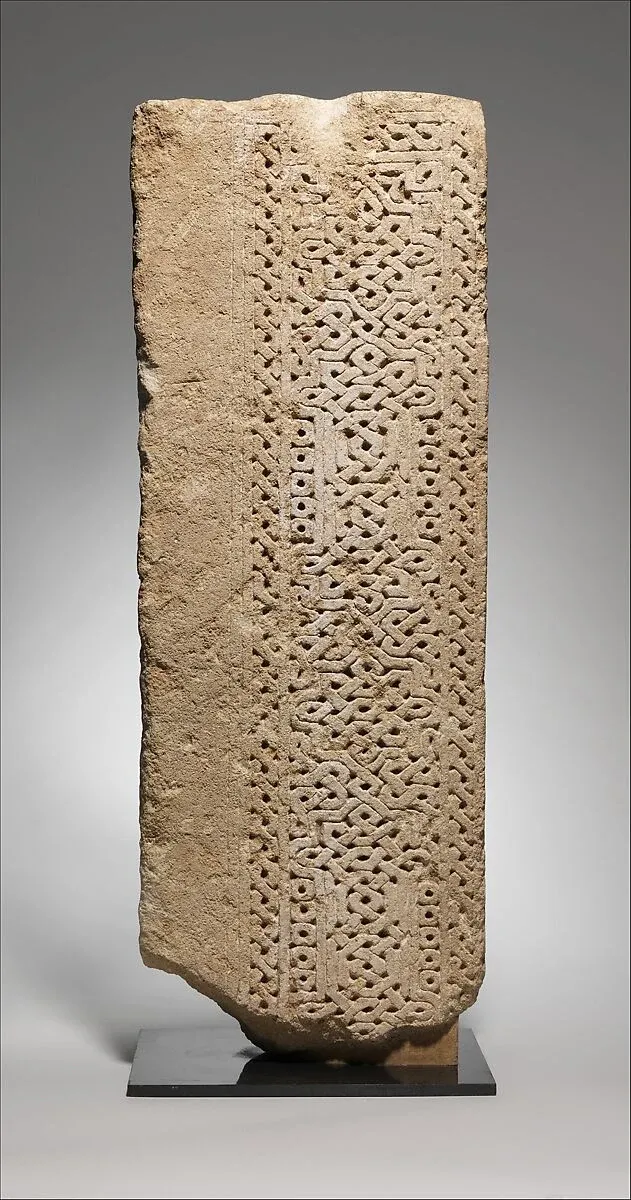
A pattern can outgrow the surface that contains it. At the edge of a carved panel, part of an interlace disappears, but you can imagine where the next strand would go. In a mosaic, a border can have the opposite effect. It turns the eye inward and makes the space inside feel complete. Both effects depend on the way a repeated unit meets an edge.
A Nasrid limestone panel in The Metropolitan Museum of Art includes bands of interlace and eight-pointed stars. It is carved on three faces. An inscription on a narrow face repeats a blessing for good health. Following the carved lines around the corner of the object brings geometry and writing into the same field of view.
Rules the hand can follow
An eight-pointed star can be constructed from two squares turned relative to one another. That construction is one way to analyze a star. It does not tell us exactly how a particular stoneworker laid it out or what the motif meant to the person who commissioned it. Tool marks, material, context and surviving records speak to those questions.
The panel is fragmentary, and the museum presents more than one possibility for its original position. It may have been part of a door frame or a windowsill. That uncertainty changes the way we read the cut edges. A surviving edge might have been a deliberate stopping point, or it might be where the rest of the pattern was lost.
A different kind of frame
A Roman mosaic from Daphne, also in The Met, uses patterned surroundings to frame a central figure. The floor panel dates to the second century CE. Its colored pieces make the pattern through adjacency. A carved limestone line makes a pattern through the relief it leaves and the shadow that relief casts. Both surfaces let the eye track repeated units, while each material gives a different kind of line.
The view matters, too. A floor pattern is encountered while approaching, crossing or looking down. A panel on a wall or opening presents other possible viewpoints. A pattern can draw the eye across a large field or focus it on a center. Those effects belong partly to its geometry and partly to where a viewer stands.
A comparison with limits
A star, a square or an interlace can recur in objects separated by time and place. Comparing their constructions can make the similarities legible. Establishing a history of contact or transmission takes other evidence, such as dated objects, records or a traceable chain of workshops. Start the comparison by tracing a unit, following it toward an edge and noting what the object does there. That gives the next historical question a precise place to begin.